
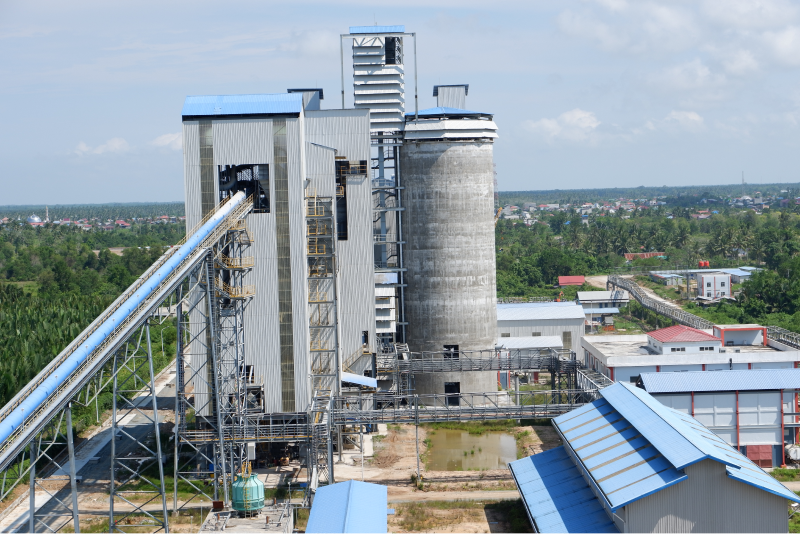
Cement manufacture, as we all know, may be separated into three processes: raw material preparation, clinker production, and completed cement production. The cement grinding facility is an essential component of final cement manufacture. The cement grinding plant, also known as the cement grinding unit, grinds clinker into certified cement. Cement grinding plants are becoming more widespread as the cement industry develops. At this stage, we are blending the calcined clinker and mixed materials in a certain proportion and then grinding to the desired particle size to create the finished cement product we require.
The silicate cement manufacturing method is typical of cement manufacturing. It is constructed of limestone and clay. It is crushed, compounded, and ground to form raw materials, which are then fed into the cement rotary kiln to calcine the cement clinker, and all ingredients are processed into finished cement after adding the required amount of gypsum (occasionally blended with mixed materials or admixtures).
Why we need cement grinding?
The main function of cement clinker grinding is to provide a finished cement product with a certain particle composition. The dispersion of cement can be expressed by fineness and specific surface area. Under the same mineral composition, the higher the dispersion, the finer the cement, the faster the hydration speed, the higher the strength, especially the early strength, but when the specific surface area exceeds a certain limit, the strong growth is not obvious, and the power consumption will increase sharply. The grinding process is different, even if the specific surface area is the same, the strength will be different.
Why is the cement grinding plant so crucial?
The cement production arrangement is to build a cement clinker production line in the mining area and a cement grinding plant near the cement sales market to save transportation expenses. If the clinker manufacturing line is built close to the city, each 1t of clinker produced requires around 1.6t of cement raw material, and transportation costs should be increased by 60%. Because the majority of the mixed materials generated by the city are brought to the cement factory built near the mine, ground into cement, and then transported to the city if the cement grinding plant and the clinker production line are built together in the mine. Transportation prices have risen. As a result, the clinker production line should be constructed near the mine, while the cement grinding station should be constructed near the market. The cement grinding plant is an environmentally friendly enterprise.

What equipment is required for the cement grinding plant?
AGICO Cement, as a cement grinding mill manufacturer, can deliver a cement EPC project as needed. We have extensive expertise designing cement plants and manufacturing cement machines such as cement crushers, cement ball mills, cement vertical mills, cement roller presses, cement kilns, dryers, clinker coolers, and other cement equipment. Based on our experience and superior technology assistance, we will help you understand everything about the cement grinding plant, and you are welcome to contact us for more information.
Cement grinding machines
Cement roller presses, cement silos, belt conveyors, cement mills, classifiers, bucket elevators, packing machines, dust collectors and other equipment are necessary for the cement grinding plant.
- The cement silo is used to store cement clinker, gypsum, and mixture in a specific proportion.
- The belt conveyor is used to mix and move the cement clinker, gypsum, and mixture.
- Cement roller presses and mills are used to grind cement raw material to the desired particle size and packing. A ball mill and a vertical cement mill are the two types of cement mills.
- The packing machine is used to load the finished cement product into a bag based on weight.
- The dust collector is used to treat the dust produced during the cement grinding process in order to ensure that the dust emission meets national standards.
Cement grinding process
The cement grinding plant’s overall workflow is as follows: the cement clinker, gypsum, and mixture in the cement silo are mixed in a specific proportion by the belt conveyor and conveyed to the cement roller press, cement mill, or group of them for grinding. The cement mill grinds the cement to the desired particle size. The machine is screened, and the qualified cement is transported by bucket elevator to the cement silo, where it is packaged by the packaging machine, and the dust generated in the process is discharged into the dust collector’s air after-treatment.
How do to choose cement grinding equipment?
Without a doubt, the cement grinding mill and cement roller press are the heart of the cement grinding unit. The choice of cement grinding machine has a direct impact on the quality and cost of the entire cement grinding unknit. According to actual cement projects, there are three common cement grinding plant solutions.
- Cement roller press and ball mill
- Closed-circuit cement mill
- Cement crusher and ball mill
In conclusion, the initial solution will be the best. The second method has the advantage of being simple to maintain, but it consumes a lot of energy, which makes it uncompetitive on the market. The third has issues with crushing impact and stable operation. The cement roller press and ball mill group will be more recommended.
Advantages
- The cement roller press was introduced in the 1980s, and after 20 years of development, it has been discovered to be a mature pre-grinding technology.
- The cement roller press may substantially improve ball mill production, reduce ball mill specifications, and lower ball mill investment.
- The cement roller press may conserve power and enhance admixture proportion, extend the service life of the ball mill, reduce cement production costs, and increase the benefits of the cement grinding unit.
- The cement roller press also considerably reduces ball mill noise, which is beneficial to the worker’s physical and psychological wellbeing.
The concepts outlined above are merely a synopsis of those that emerged during the analysis of AGICO Cement’s plans to build a grinding mill. In truth, each option has its own set of advantages and downsides. There is no ideal solution. The main point is that while making a decision, clients should be clear about their objectives. We must assess the program’s advanced and mature character, as well as whether the company’s staff quality is adequate. For example, the closed-circuit vertical mill grinding technology is undoubtedly the most modern in terms of lowering electricity consumption per tonne of cement and lowering operational expenses. However, it is not acceptable since some of the equipment and particle size of the grinding plant are not optimal. As a result, considering the cost of the grinding plant and ensuring the quality of the cement, we agree that the form of roller press + closed circuit ball mill is appropriate at this time.
